StoryAnalysis
Siena Put Hochul Up 14, and the Governor Market Moved One Point Because It Was Already Past the Voters
Kalshi had a Democratic hold at 96% on October 29, 2026, a point above its price before Siena's poll, which means the exchanges were already surer of a Hochul win than the 68% of voters who expect one.
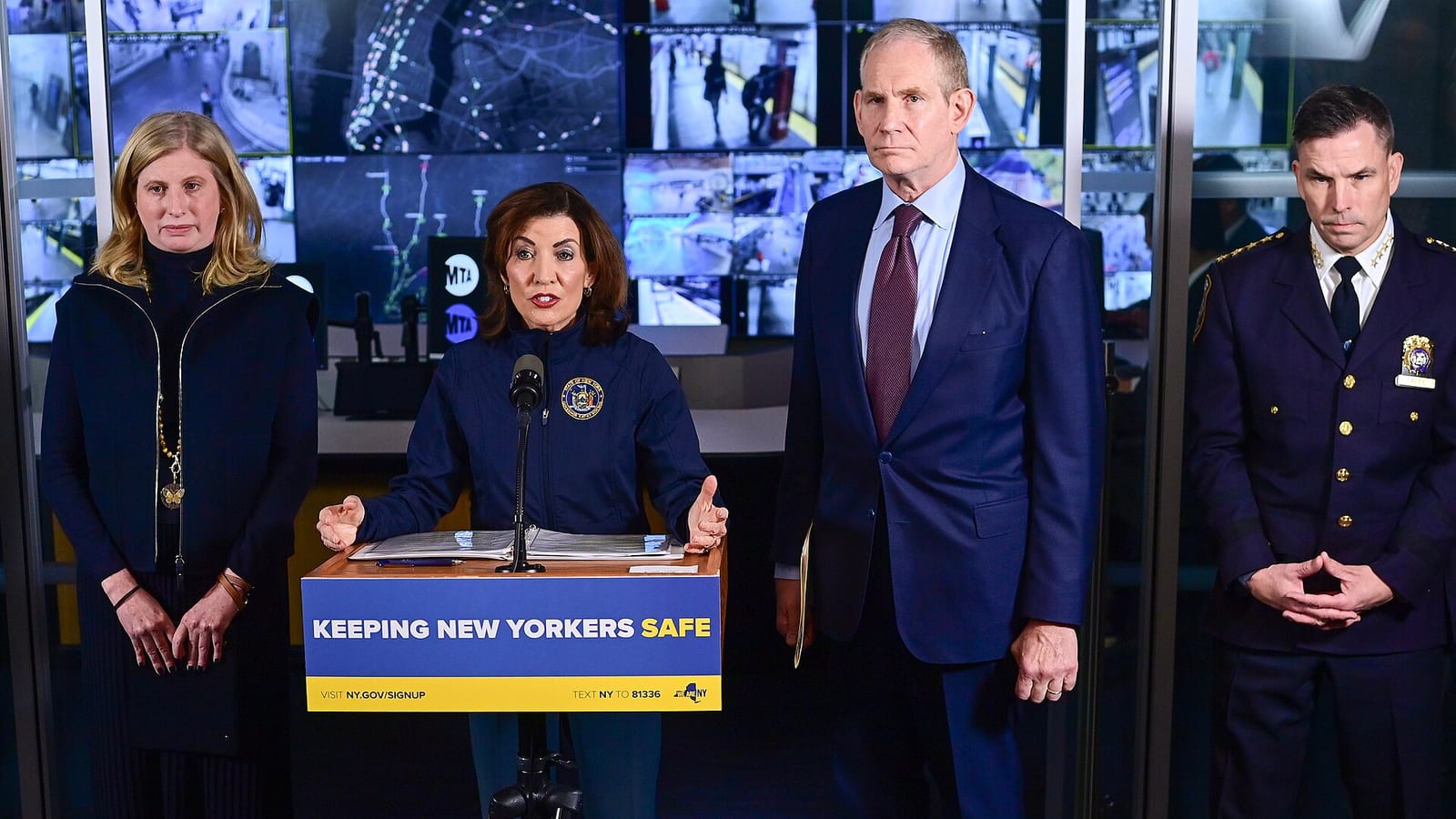
Siena's poll of likely New York voters, released on October 28, 2026, widened Governor Kathy Hochul's lead over Republican Bruce Blakeman to 14 points, 54% to 40%, and the governor's market gained a single point, because the exchanges had already gone further than the voters. Kalshi's price on the Democratic Party holding the governorship went from 95% on October 23, 2026 to 96% on October 29, 2026, and Polymarket's from 96% to 97%, while the same poll found voters expecting a Hochul win by 68% to 23%. The poll confirmed a read the exchanges already held; it did not give them a new one.
Both venues price the race, and both moved the same way over the six days that took in the poll's release and the opening of early voting on October 24. Polymarket's price on a Republican win slipped from 4% on October 23 to 3% on October 29, 2026, and Kalshi's from 6% to 5%. A one-point move on every line, in the week Siena put the challenger further behind than in either of its two earlier polls of likely voters, says the market had treated a Democratic hold as the near-certain outcome before Siena published a number.
What the Siena poll found five days out
The Siena Research Institute surveyed 807 likely voters from October 19 to October 22, 2026, by phone and by text to web, and puts its margin of error at 4.1 percentage points. Hochul's 54% matches the highest share she has recorded in Siena's trend on this race, reached once before in January 2026, and Blakeman's 40% is a point below his 41% in September. In Siena's two previous polls of likely voters, Hochul led 50% to 41% on September 22 and 49% to 39% on August 12, so the gap has gone from 10 points to nine to 14, with almost all of the October change coming on Hochul's side of the ledger as undecided voters fell from 9% to 6%.
The geography is where the poll is most specific. Hochul led 67% to 23% in New York City, and the race was close everywhere else: 49% to 47% in the downstate suburbs and 49% to 48% upstate, both with Hochul nominally ahead, which leaves almost all of her statewide lead in the city. Among independents she led 51% to 40%, a reversal from September, when Siena had Blakeman ahead with that group 44% to 39%. Steven Greenberg, Siena's pollster, framed the arithmetic plainly in the release: a Republican needs to win upstate and the suburbs "convincingly" and carry independents by a significant margin to offset New York City and the Democrats' two-to-one enrollment edge, and with a week to go Blakeman was doing none of the three.
The poll also measured the candidates themselves. For the first time in Siena's polling, a majority of likely voters, 51% to 45%, viewed Hochul favorably, and 51% approved of the job she is doing against 46% who disapproved. Blakeman's favorability was split, 39% to 40%. On the rest of the statewide ballot, Letitia James led Saritha Komatireddy 54% to 39% in the race for attorney general and Tom DiNapoli led Joseph Hernandez 59% to 32% for comptroller, and Democrats led the generic congressional ballot 54% to 39%, which Greenberg cautioned was not a forecast for any single district.
Why the market moved one point on a 14-point poll
The market treats the governor's race as a question of structure rather than of campaign events, and that is why a strong poll for the incumbent had so little left to move. A price of 96% on Kalshi on October 29, 2026 is a market that has already absorbed a double-digit lead; the poll's new information was the size of the lead, and the size of a lead matters to a winner-take-all contract only when it crosses from comfortable to uncertain or back. Siena's numbers pushed it further from that line, not across it.
The more telling figure in the release is the one Greenberg introduced with a question, "When does prediction become reality?" Asked who they think will win regardless of how they plan to vote, 68% of likely voters named Hochul and 23% named Blakeman, with 9% unsure. Among Republicans in the poll, 49% expected Blakeman to win and 40% expected Hochul to. That is a voter body still leaving roughly one chance in four to the challenger, against exchanges where Polymarket had a Blakeman win at 3% and Kalshi at 5% on October 29, 2026. The difference is the read in one number: traders are pricing the result, voters are still describing a campaign.
The read here is not that the exchanges know something the voters do not. They are pricing what Greenberg's own sentence describes, a statewide electorate in which a Republican has to win nearly everything outside New York City by a wide margin, and they are pricing it on a contract that pays on the winner alone, so a lead of 14 points and a lead of nine land in nearly the same place.
The case against reading the poll as a formality
The strongest objection is that the polls do not agree on the parts of the state the race turns on, and a market that barely shifted could be leaning on the wrong one. Marist's poll of 1,361 registered voters, taken October 1 to 4, 2026 and released October 7, had Hochul ahead 53% to 42%, but it found independents breaking for Blakeman 49% to 42% and Blakeman winning upstate with 51%. Siena, three weeks later and among likely rather than registered voters, has Hochul ahead with independents by 11 points and level upstate. Two credible polls disagreeing on the independent vote by that much is the kind of disagreement a 96% price does not leave much room for.
There is also the margin itself. Siena's stated error of 4.1 points is larger than the four-point rise in Hochul's own share since September, and the fieldwork closed on October 22, two days before early voting opened, so nothing in the poll measures how the first week of in-person ballots has gone. And the market has shown it does respond to the campaign: Kalshi's Democratic price went from 95% on October 12, 2026 to 94% on October 15, 2026, after the October 13 debate in which Blakeman put distance between himself and President Trump, and from 94% to 96% by October 29, a recovery over the same stretch in which Siena found him losing independents. A market that moves on a debate is a market that could move on something else in the last five days.
What would change the read
The read is that the exchanges priced a Democratic hold before Siena did and that nothing in the poll asked them to reconsider. The dated places it could break:
• November 1, 2026: the last day of early voting at poll sites across the state, which opened on October 24
• November 2, 2026: the last day to apply in person for a mail ballot at a county board of elections
• November 3, 2026: Election Day, with polls and ballot drop-off open until 9 p.m., and the day a mail ballot must be postmarked
If Kalshi's Democratic price falls below 90% before the polls close on November 3, 2026, the market has stopped treating the outcome as settled and this read is wrong. If it holds where it was on October 29, the poll will have been what it looks like now, a confirmation of a price that was set weeks earlier.
Voting closes at 9 p.m. on November 3, 2026, and each venue's contract then settles on its own published terms. The debate's one-point effect on the same market is in the earlier story on Blakeman's debate distance from Trump. The live board, the contract's settlement terms and how the price has moved since September are on the New York governor market page, and the profile of Kathy Hochul carries her record in office.
Questions readers are asking
What did the new Siena poll show in the New York governor's race?
Siena's poll of 807 likely voters, taken October 19 to 22 and released October 28, 2026, had Governor Kathy Hochul ahead of Bruce Blakeman 54% to 40%, up from 50% to 41% in September, with a margin of error of 4.1 points.
Did the Siena poll move the Hochul Blakeman odds?
Only by a point. As of October 29, 2026, Kalshi had the Democratic Party at 96% to win and Polymarket at 97%, each a point above October 23, and Polymarket had a Republican win at 3%, down from 4%.
Do voters think Hochul will win?
Most do. In Siena's poll released October 28, 2026, 68% of likely voters said they expect Hochul to win and 23% expect Blakeman to, and among Republicans 49% expect Blakeman to win while 40% expect Hochul to.
Is the governor's race close anywhere in New York?
Yes, outside New York City. Siena's poll released October 28, 2026 had Hochul ahead 67% to 23% in the city but only 49% to 47% in the downstate suburbs and 49% to 48% upstate, and Marist's poll released October 7, 2026 had Blakeman at 51% upstate.
When is the New York governor election and when does early voting end?
The general election is November 3, 2026, with polls open until 9 p.m., and early voting at poll sites runs from October 24 through November 1, 2026, according to the New York City Board of Elections.