StoryLocal news
The Second Circuit Refused to Shield Kalshi From New York, and Its One-Sentence Order Gave No Reasons
The panel's November 3, 2026 order denies three motions in one sentence, which leaves Kalshi without the protection it sought from New York's gaming officials and leaves the morning's questions from the bench as the only sign of the judges' thinking.
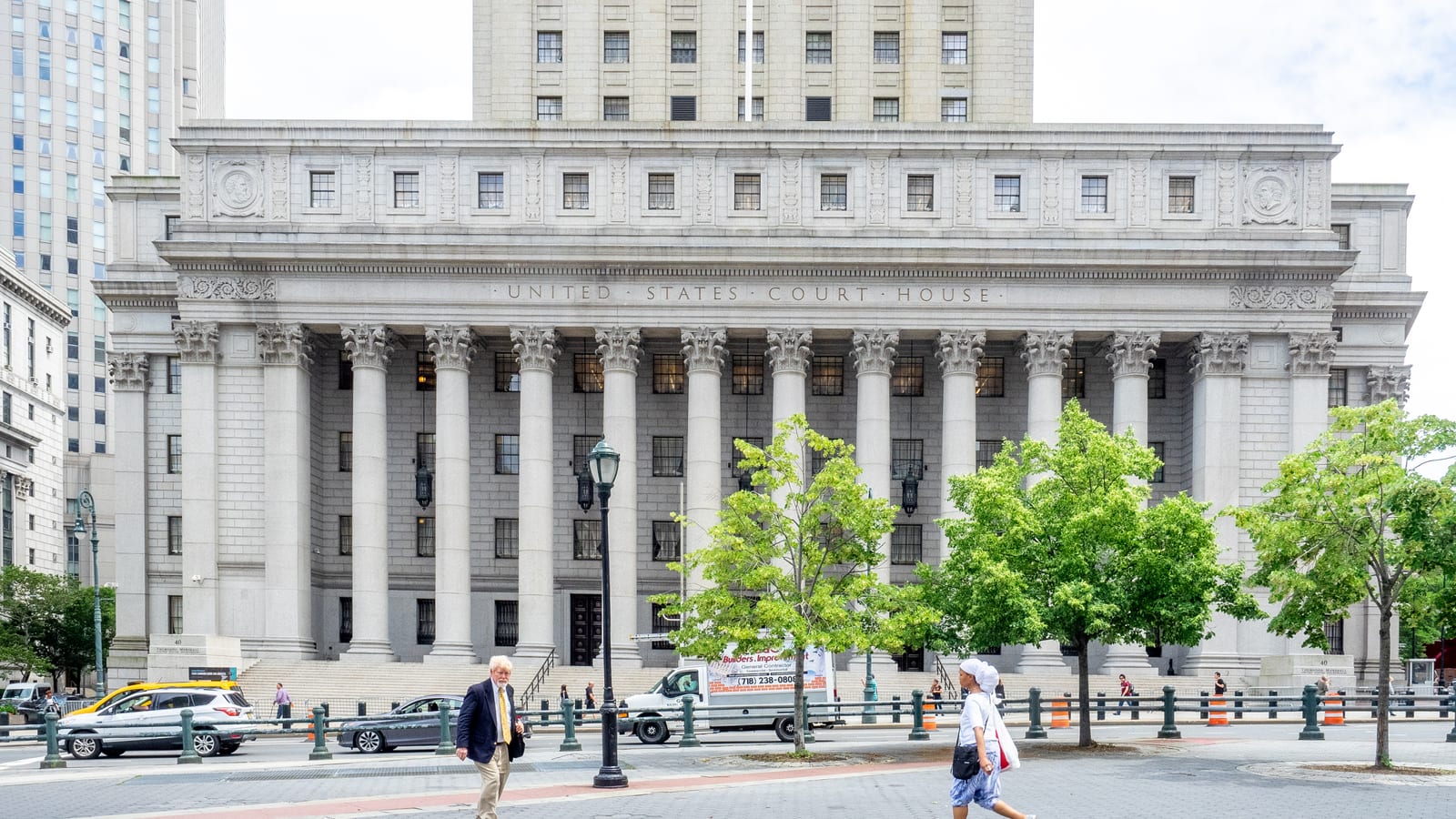
A three-judge panel of the U.S. Court of Appeals for the Second Circuit on November 3, 2026 denied Kalshi's motion for an injunction pending appeal against New York's gaming officials, in an order that runs a single sentence and gives no reason beyond the legal standard it cites. The Kalshi Second Circuit injunction request was argued that morning at the Thurgood Marshall United States Courthouse in Manhattan, with a lawyer for the Commodity Futures Trading Commission arguing on Kalshi's side as a friend of the court, over New York's objection.
The order was entered on November 3, 2026 as docket entry 74 in No. 26-1835, KalshiEX LLC v. Williams, the appeal Kalshi brought against Robert Williams in his official capacity as Executive Director of the New York State Gaming Commission. It lists Circuit Judges John M. Walker, Jr., Dennis Jacobs and Joseph F. Bianco as present, and it decides three appeals at once: Kalshi's New York appeal, a second Kalshi appeal against Connecticut's consumer protection commissioner (No. 26-2239), and an appeal by Coinbase Financial Markets, Inc. against Connecticut Attorney General William Tong (No. 26-2297). Gaming attorney Daniel Wallach posted the order shortly after 5 p.m. Eastern, and InGame quoted the same text. It is New York's case: the officials Kalshi asked the court to restrain are the state's gaming regulators, and the ruling under appeal came from the federal court in Manhattan.
What the one-sentence order says
The operative text, in full: "Appellants in these three appeals, which are being considered in tandem, move for an injunction pending appeal. Upon due consideration, it is hereby ORDERED that the motions are DENIED because Appellants have failed to make the required showing that an injunction pending appeal is warranted." For the required showing it cites a 2020 Second Circuit decision, Agudath Israel of America v. Cuomo, and it is signed for the court by the Clerk of Court, Catherine O'Hagan Wolfe.
That is the whole of the court's explanation. The order does not say which part of the test Kalshi and Coinbase failed, whether the panel doubted their chances on appeal, weighed the harm to the companies against the harm to the states, or both. It does not describe the argument or respond to the CFTC. The questions the judges asked from the bench a few hours earlier are the only public record of what was on their minds, and a question asked at argument is not a holding.
Who argued, and why the CFTC was in the room
The argument began at about 10 a.m. and ran roughly an hour, according to the live account Inner City Press posted from the courtroom; Wallach wrote at 11:07 a.m. that the hearing had concluded and the matter was under advisement. InGame, in an account by Daniel O'Boyle, named the lawyers: Will Havemann for Kalshi, Yaira Dubin for Coinbase, Henry Dickman for the CFTC, Ester Murdukhayeva for New York and Michael Nunes for Connecticut.
The CFTC is not a party to the appeal. The Second Circuit granted its motion to take part in the argument as amicus curiae on October 30, 2026, Wallach reported that day, and The PM Pulse reported the same ruling on November 2. New York had opposed the request; Wallach's summary of the state's filing said New York argued the agency is not a party and would add little, and noted that the CFTC is suing the state in a separate case in which its own injunction motion is still pending.
What the judges asked Kalshi, Coinbase and the CFTC
Havemann opened on harm. According to InGame, he told the panel that New York's state court lawsuit "would shut down a federally regulated exchange," reaching "not just sports contracts, but all event contracts, and not just in New York, but nationwide." Inner City Press recorded him telling the court on November 3, 2026 that the case "could be remanded tomorrow," and, asked whether Kalshi would be satisfied if the state agreed to hold off, answering "Absolutely."
Judge Walker moved the discussion to the merits, and specifically to whether a contract on a sports result fits the federal definition of a swap. InGame quoted him: "I don't see how sports betting in its entirety is a swap. Because there has to be an underlying event, and the underlying event has to be associated with potential financial economic or commercial consequences." Judge Bianco, by the same account, said, "It feels like we're trying to fit a square peg into a round hole here. The definition was conceived of with regard to financial markets. Now it's being applied to a different situation." Havemann answered that breadth was the point: "Everything about the swap definition was intended to be broad. Because Congress was worried about trading happening off exchange," adding that Congress then gave the CFTC "additional power over contracts involving gaming."
Dubin, for Coinbase, asked the panel to look past player props and mention markets to the plainest contract. "This is not about the edge cases. It's about the core category of sports event contracts, which is 'who wins X game?'" Dubin said, according to InGame, adding that "there is no sports carve-out" in the Commodity Exchange Act. Bianco replied that he could not see a reading of economic consequence broad enough to cover those contracts that would not also turn ordinary wagers placed with licensed betting companies into off-exchange swaps. "The CFTC can say there's a distinction, but I don't see it," InGame quoted him.
Dickman told the court on November 3, 2026 that the agency is "actively engaged right now in building a framework around event contracts," is "instructing exchanges to take down contracts that are not within the public interest," and is "bringing enforcement actions against those who insider trade or manipulate markets." Inner City Press recorded his warning that if the states win, the CFTC would be unable to pursue insider trading, and Bianco's reply, in its paraphrase: "Isn't the CFTC trying to make sports gambling a swap? Congress did not silently think it was putting you in charge of gambling." When the CFTC's lawyer described the agency's rulemaking, a judge asked about Loper Bright v. Raimondo, according to the same account.
What the judges asked New York and Connecticut
The questions for the states, InGame reported, turned from the merits to the harm of letting them enforce now. Walker asked Murdukhayeva why New York could not keep waiting, as it had until the district court ruled: "You put off until July any regulation. Why couldn't you continue that?" He also asked the state to confirm that the order the state seeks against Kalshi "would have an impact over the whole country."
Inner City Press's account of the same exchange is fuller on the calendar. A judge said the appeal itself could be heard this winter or in March, and asked whether the state could commit to not enforcing until then. New York's lawyer answered that no representations could be made, pointed to three pending petitions for review at the Supreme Court, and said the state should not be barred from enforcing its own laws. The state's lawyer also told the panel that with an injunction in place, Kalshi would keep offering its contracts to 18 to 21 year olds, and that the national reach of any order belongs to a different case, the Attorney General's.
For Connecticut, Nunes argued that Kalshi had shown no irreparable harm and pointed to its $40 billion valuation and its new NBA partnership. Walker, by InGame's account, asked whether that valuation rests on the sports contracts, which would mean losing them does hurt the business.
What the denial means for New York's cases
The order settles only the question of interim relief. The appeal underneath it is from Judge Analisa Torres's July 7, 2026 denial of Kalshi's motion for a preliminary injunction in the Southern District of New York, case 25-cv-8846, and on July 27 Torres refused to grant an injunction pending appeal, concluding that Kalshi could not make the "strong showing" of likely success the standard requires, according to Covers. The Second Circuit has now refused the same interim relief. Kalshi's appeal itself remains pending, and nothing in the November 3 order addresses its merits.
The denial also bears on the state's own enforcement case. Attorney General Letitia James filed a proceeding against Kalshi in state court on July 31, 2026 under Executive Law section 63(12), and Kalshi removed it to federal court; a joint letter both sides filed on October 30, 2026 described the state's motion to send it back to state court as still pending. That fight was the subject of an earlier story on where the case belongs. Wallach's reading after the ruling was that New York and Connecticut are now "one remand order away from state court civil enforcement," and that the CFTC's and Novig's own injunction motions against New York face a steeper path. That is one lawyer's analysis, not a ruling, and no judge has decided the remand motion.
The ruling also lands a day after a separate step in Manhattan. On November 2, 2026, the Attorney General asked a state judge to make Kalshi answer a subpoena about its advertising, a petition covered in the story on the advertising subpoena. That proceeding is not part of the appeal and the order does not touch it.
What the order does not decide
The order does not hold that sports event contracts are or are not swaps, does not decide whether federal law preempts New York's licensing rules, and does not itself require Kalshi to stop offering anything in New York. It denies a request for protection while the appeal runs, and it states only that the companies did not make the showing the standard requires. The judges' questions about the swap definition, the harm to Kalshi and the CFTC's authority were questions; none of them is a finding, and the panel did not adopt any of them in writing.
What comes next
No argument date on the merits of No. 26-1835 appears in the order or in the accounts of the hearing; the only timing on the record is a judge's remark from the bench that the appeal could be heard this winter or in March. The Attorney General's remand motion in federal court has no decision date on the public record either. The next fixed date in the wider fight over sports event contracts is at the Supreme Court, where Kalshi's response to New Jersey's petition is due on December 7, 2026 after the Court granted an extension on October 30, according to The PM Pulse. Filings in New York's prediction market cases are listed on the legal status page.
Questions readers are asking
Did the Second Circuit rule on Kalshi's injunction against New York?
Yes. On November 3, 2026, a panel of Judges John M. Walker, Jr., Dennis Jacobs and Joseph F. Bianco denied Kalshi's motion for an injunction pending appeal in No. 26-1835, saying only that the companies had not made the required showing.
Does the Second Circuit order ban Kalshi in New York?
No. The November 3, 2026 order denies interim protection while Kalshi's appeal is decided; it does not decide the appeal, does not rule on whether sports contracts are swaps and does not itself order Kalshi to stop offering anything.
Why did the CFTC argue in Kalshi's appeal against New York?
The Second Circuit let the Commodity Futures Trading Commission argue as amicus on October 30, 2026, over New York's objection that the agency is not a party; its lawyer, Henry Dickman, told the panel the agency is building a framework for event contracts.
What did the judges ask at the Kalshi Second Circuit argument?
Judge Walker said he did not see how sports betting in its entirety is a swap, and Judge Bianco compared the argument to fitting a square peg into a round hole, according to InGame; the judges also asked New York whether it could hold off enforcing until the appeal is heard.
When will the Second Circuit hear Kalshi's New York appeal?
No date is set. A judge said from the bench on November 3, 2026 that the appeal could be heard this winter or in March, according to Inner City Press; the next fixed date in the wider fight is December 7, 2026, when Kalshi's Supreme Court response to New Jersey is due.